

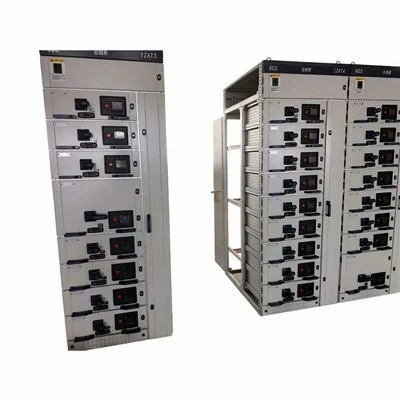
Product Overview
Low Voltage Distribution Panels manage and distribute electrical power safely from incoming utility feeds or transformers down to branch circuits. Rated up to 1000V AC, these assemblies integrate circuit breakers, switch disconnectors, metering devices, and busbar systems within a freestanding modular enclosure. Engineered for primary and secondary power distribution in industrial plants, commercial buildings, and infrastructure projects, each unit is built strictly to project-specific single-line diagrams (SLD), short-circuit current ratings (SCCR), and coordination requirements.
Technical Specifications
|
Parameter |
Specification Range |
|
Rated Operational Voltage (Ue) |
Up to 690V AC, 50/60 Hz |
|
Rated Insulation Voltage (Ui) |
Up to 1000V AC |
|
Rated Current (In) |
Up to 6300A (Incoming / Main Busbars) |
|
Short-Circuit Withstand (Icw) |
Up to 100kA for 1s |
|
Enclosure Protection (IP Rating) |
IP30 to IP54 (Indoor/Outdoor configurations) |
|
Form of Internal Separation |
Form 1 to Form 4b (IEC 61439-1/-2) |
|
Busbar Material |
Electrolytic Copper (T2 / ETP Grade, 99.9% purity) with tin or silver plating |
|
Enclosure Material |
Cold-rolled steel sheet (1.5mm–2.0mm frame/doors) with electrostatic powder coating |
|
Standard Compliance |
IEC 61439-1/-2, IEC 60947, UL 891 (optional configuration) |
Key Features
Modular Enclosure Framework: Built with roll-formed 3D profile sections bolted together, providing structural rigidity without excessive weight while enabling flexible internal compartmentalization.
Optimized Busbar Architecture: Main and distribution busbars are sized based on current density (A/mm2) and thermal rise limits, supported by high-dielectric SMC/BMC insulators to withstand electrodynamic forces during fault conditions.
Internal Arc Mitigation: Ventilation pathways and pressure-relief flaps direct arc gases away from operators during internal arcing faults, mitigating catastrophic failure risks.
Flexible Cable Entry: Removable gland plates on top and bottom support bottom-entry or top-entry cabling for power, control, and communication lines.
Component Integration: Accommodates fixed, plug-in, or withdrawable Air Circuit Breakers (ACBs) and Molded Case Circuit Breakers (MCCBs) from major brands (Schneider, ABB, Siemens, Eaton).
Applications
Commercial Real Estate: High-rise office buildings, shopping malls, and hospitals requiring reliable multi-floor sub-distribution.
Industrial Manufacturing: Automotive plants, chemical processing units, and heavy machinery workshops requiring continuous heavy-load distribution.
Data Centers: Mission-critical server facilities requiring redundant feed configurations and high short-circuit ratings.
Infrastructure & Utilities: Water treatment plants, railway power supply stations, and airport terminal buildings.
Customization
Engineered to project-specific single-line diagrams, schematic drawings, and dimension constraints.
Enclosure Dimensions: Height, width, and depth adjusted to fit designated electrical room layouts.
Incoming/Outgoing Configurations: Top/bottom entry, side extensions, busduct connections, and metering compartments.
Control Logic: Integration of PLCs, energy meters, surge protective devices (SPDs), and remote status monitoring via Modbus/Profibus protocols.
Surface Finishing: Custom RAL color powder coating and anti-corrosion treatments for coastal or high-humidity environments.
Manufacturing & Quality Control
Sheet Metal Fabrication: Automated CNC laser cutting, CNC turret punching, and robotic bending machines maintain dimensional accuracy within +/- 0.2mm for enclosure frames.
Busbar Processing: CNC copper busbar punching, cutting, and bending machines ensure precise geometry and clean contact surfaces. Torque wrench calibration is logged during assembly to prevent joint hotspots.
In-House Testing Protocol:
Dielectric strength test (power frequency withstand voltage up to 2.5kV for 1 minute).
Insulation resistance measurement (> 100M ohms using a 1000V megohmmeter).
Mechanical operation and interlock verification for drawers, doors, and circuit breaker racking mechanisms.
Primary and secondary current injection testing available upon request.
Certifications & Documentation
Type Test Reports (TTR): Certified compliance reports covering temperature rise limits, dielectric properties, short-circuit withstand strength, and electromagnetic compatibility (EMC).
Quality Management: Manufactured under ISO 9001, ISO 14001, and ISO 45001 certified operations.
Shipped Documentation Package:
As-built electrical schematics and wiring diagrams (DWG/PDF).
Bill of Materials (BOM) listing component manufacturers and model numbers.
Factory Acceptance Test (FAT) individual test sheets.
Component operation and maintenance (O&M) manuals.
Packaging & Delivery
Export Packaging: Units are bolted to heavy-duty fumigated wooden skids, wrapped in moisture-barrier PE film, and enclosed in robust export-grade plywood crates. Internal components vulnerable to vibration are secured or shipped separately.
Lifting & Handling: Enclosures include lifting lugs and removable base channels for crane or forklift transport on job sites.
Lead Time: Standard production takes 4 to 6 weeks following approval of final shop drawings. Sea and air freight options available from major export ports.
FAQ
Hot Tags: low voltage distribution panels, China low voltage distribution panels manufacturers, suppliers, factory