

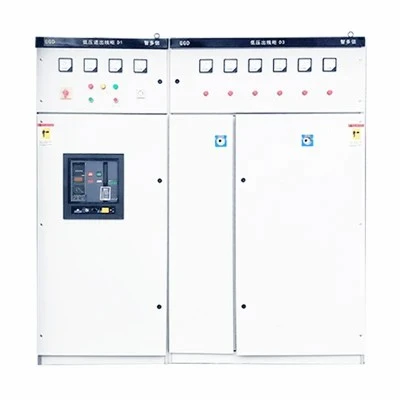
Products Description
The Fixed Motor Control Center (MCC) consolidates multiple motor starters, feeder circuits, and control components into a rigid, freestanding modular enclosure. Built for continuous industrial duty, each functional unit is rigidly bolted rather than withdrawable, delivering high mechanical stability, lower internal contact resistance, and a cost-effective footprint for centralized motor management up to 690V AC.
Technical Specifications
|
Parameter |
Specification |
|
Rated Operational Voltage (Ue) |
Up to 690V AC, 50/60 Hz |
|
Rated Insulation Voltage (Ui) |
1000V AC |
|
Main Busbar Current Rating |
Up to 4000A |
|
Short-Time Withstand Current (Icw) |
Up to 65kA (1s) |
|
Peak Withstand Current (Ipk) |
Up to 143kA |
|
Degree of Protection |
IP30 / IP40 / IP54 (per IEC 60529) |
|
Form of Separation |
Form 1 to Form 4b (per IEC 61439-2) |
|
Busbar Material |
Electrolytic Copper (EC Grade, >= 99.9% purity), tin/silver-plated joints |
|
Enclosure Material & Thickness |
Cold-rolled steel sheet, 2.0mm frame / 1.5mm door and panels |
|
Standard Compliance |
IEC 61439-1 & -2, IEC 60947-4-1 |
Key Features
Rigid Compartmentalized Architecture: Internal steel partitions separate functional units, busbar chambers, and cable compartments, preventing localized faults from escalating.
Optimized Busbar Thermal Design: Main and distribution busbars utilize high-conductivity copper profiles sized for 1.2A/mm2 current density, maintaining safe thermal limits under 100% continuous load.
Direct Cable Termination Access: Generous cabling zones equipped with removable gland plates and slotted rail supports accommodate multi-core armored power cables and heavy control wiring.
Coordination Type Protection: Starter compartments configured to IEC 60947-4-1 Type 2 coordination, ensuring zero damage to contactors and overload relays during short-circuit clearing.
Surface Protection Treatment: Enclosure components undergo a multi-stage iron phosphating pretreatment followed by electrostatic epoxy-polyester powder coating (RAL 7035 texture finish) at 80 to 120 um film thickness.
Applications
Water & Wastewater Treatment: Centralized control for raw water intake pumps, high-pressure booster pumps, and chemical dosing skids.
Mining & Mineral Processing: Continuous operation motor management for heavy-duty conveyors, crushers, and slurry agitators.
Oil & Gas Infrastructure: Power distribution and auxiliary motor control in non-hazardous utility and offsite balance-of-plant (BoP) buildings.
Heavy Manufacturing & Metallurgy: Integrated control panels for rolling mill auxiliary drives, industrial ventilation fans, and compressor plants.
Customization
Enclosure Dimensions & Layout: Section widths (600/800/1000mm), depths (600/800/1000mm), and front/rear access configurations tailored to electrical room footprints.
Component Brand Integration: Incoming breakers, contactors, and protection relays sourced from customer-specified tier-1 brands (Schneider, ABB, Siemens, Eaton) or standard factory-vetted alternatives.
Control & Metering Options: Integration of multi-function power meters, PLC communication modules (Modbus RTU, Profibus, Profinet, Ethernet/IP), and analog pilot devices on compartment doors.
Cable Entry Direction: Top or bottom entry arrangement with customizable removable gland plates matching site cabling schematics.
Manufacturing & Quality Control
Sheet Metal Fabrication: CNC fiber laser cutting and multi-axis CNC press brake bending maintain dimensional tolerance within +/- 0.2mm for enclosure frames.
Busbar Processing: Automated CNC copper busbar punching, bending, and cutting lines ensure precise alignment during assembly. Torque-controlled pneumatic wrenches secure all bolted joints to specified Newton-meter values.
In-House Quality Verification:
Dielectric strength and insulation resistance testing conducted at 2.5kV / 1 min.
Primary busbar micro-ohm resistance measurement across bolted joints to verify low contact resistance (<= 20 uOhms).
Mechanical interlocking verification for door switches, breaker racking, and unit selectors.
Certifications & Documentation
Type Test Reports (TTR): Verified temperature-rise limits, dielectric properties, short-circuit withstand strength, and EMC compatibility issued by accredited third-party laboratories.
Standard Documentation Package: Supplied with as-built single-line diagrams, general arrangement (GA) drawings, schematic wiring diagrams, component BOMs, factory test reports, and operation/maintenance (O&M) manuals.
Quality Management: Manufactured under ISO 9001, ISO 14001, and ISO 45001 certified production processes.
Packaging & Delivery
Export-Grade Packaging: Enclosure sections bolted to heavy-duty fumigated wooden skids, wrapped in moisture-barrier VCI polyethylene film, and protected with shock-absorbing edge guards.
Lifting & Handling: Equipped with removable top lifting lugs and bottom forklift channels for safe on-site rigging.
Shipping Documentation: Accompanied by commercial invoices, packing lists, certificate of origin, and fumigation certificates matching container loading plans.
FAQ
Hot Tags: fixed motor control center, China fixed motor control center manufacturers, suppliers, factory