

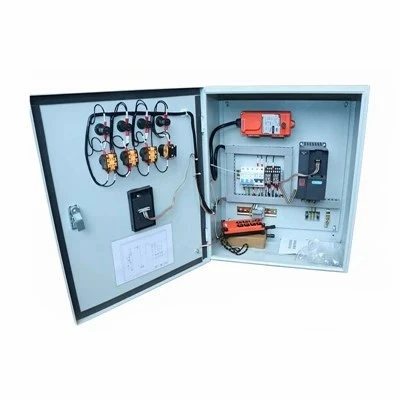
Product Overview
Engineered for primary and secondary power distribution in industrial automation lines and facility electrical rooms, these low-voltage switchgear assemblies manage electrical loads up to 6300A. Built with rigid cold-rolled steel or modular zinc-aluminum-magnesium alloy frames, the enclosures house circuit breakers, protective relays, and busbar systems to distribute power safely to plant machinery and infrastructure. Each unit is built strictly to project single-line diagrams (SLDs) and engineering layout drawings, ensuring direct integration into existing plant electrical architectures.
Technical Specifications
|
Parameter |
Specification Range |
|
Rated Operational Voltage (Ue) |
Up to 690V AC, 50/60Hz |
|
Rated Current (In) |
Up to 6300A (Main Busbar) |
|
Short-Time Withstand Current (Icw) |
Up to 100kA for 1s |
|
Enclosure Protection Rating |
IP30 to IP54 (IEC 60529) |
|
Enclosure Material Thickness |
1.5mm - 2.5mm Electro-galvanized or Cold-rolled Steel |
|
Surface Treatment |
Epoxy-polyester powder coating, textured finish, 80-120 um dry film thickness |
|
Internal Separation Form |
Form 1 to Form 4b (IEC 61439-2) |
|
Design & Testing Standards |
IEC 61439-1/-2, ISO 9001, CE Compliance |
Key Features
Modular Internal Partitioning: Compartmentalized internal layouts isolate functional units-including incoming feeders, outgoing branches, busbar chambers, and cable compartments-to prevent fault propagation and protect operating personnel during maintenance.
Optimized Copper Busbar Layout: High-purity T2 electrolytic copper busbars treated with antioxidant plating, sized according to current density requirements to restrict thermal hotspots under full load conditions.
Flexible Cable Entry Paths: Removable gland plates located at the top and bottom support bottom-entry or top-entry power cabling, multi-core armored cables, and direct busduct connections.
Integrated Thermal Management: Louver panels, forced-air cooling fan trays, or heat exchanger cutouts engineered based on internal heat dissipation calculations of installed switchgear.
Applications
Automotive Manufacturing Plants: Centralized power distribution for stamping presses, robotic welding cells, and high-duty conveyor drive lines.
Water & Wastewater Treatment Facilities: Motor control centers (MCC) and PLC integration panels engineered for continuous pump operations in high-humidity environments.
Commercial & Industrial HVAC Infrastructure: Main switchboards powering large-scale chillers, emergency backup generators, and ventilation automation systems.
Heavy Machinery Skid Integration: OEM power distribution nodes for mining machinery and port crane electrical rooms requiring seismic-resistant structural frames.
Customization
Cabinets are configured to order based on client-provided engineering drawings and site spatial constraints.
Dimensional Adaptation: Custom heights up to 2200mm, variable widths, and depths tailored to match available electrical room layouts and clearance requirements.
Switchgear Integration: Accommodation of specified circuit breaker manufacturers (Schneider, ABB, Siemens, Eaton) or installation of client-supplied free-issue components.
Control & Monitoring Add-ons: Pre-wiring for multi-function power meters, current transformers (CTs), potential transformers (PTs), and surge protective devices (SPDs).
Enclosure Finishing: RAL color matching (e.g., RAL 7035 light grey, RAL 7032 pebble grey) to match facility-wide asset color standards.
Manufacturing & Quality Control
Structural frames and panel components are processed using automated CNC laser cutting, CNC turret punching, and multi-axis bending machines to maintain dimensional tolerances within +/-0.2mm. Electrostatic powder coating lines maintain uniform paint adhesion tested for salt-spray corrosion resistance.
Factory verification includes:
Dimensional and squareness verification of welded skeletal frames prior to assembly.
Mechanical operation checks on door hinges, swing-handles, and mechanical interlocking mechanisms.
Dielectric withstand voltage testing (high-pot test) on assembled busbars and internal wiring circuits.
Primary and secondary injection testing for protective relay coordination (executed upon request).
Certifications & Documentation
Each shipment includes a comprehensive technical documentation package required for site inspection, electrical code compliance, and commissioning:
Quality & Type Testing: ISO 9001 quality management system certificates and IEC type-test compliance reports.
Routine Test Reports: Individual factory test reports verifying dielectric properties, protective circuit continuity, and mechanical operation.
Engineering Deliverables: As-built general arrangement (GA) drawings, electrical schematic diagrams, and terminal strip wiring layouts provided in editable CAD and PDF formats.
Packaging & Delivery
Enclosure Protection: Units are wrapped in heavy-duty waterproof polyethylene film, secured with edge protectors, and bolted to fumigated wooden pallets to eliminate shifting during transit.
Lifting Provisions: Removable lifting eye-bolts are installed on the top frame to facilitate safe crane rigging and vertical positioning on-site.
Freight Logistics: Containerized sea freight or flat-rack transport secured according to cargo weight distribution, with moisture-absorbent desiccant packs sealed inside compartments to control internal humidity during ocean transit.
FAQ
Hot Tags: industrial power distribution cabinet, China industrial power distribution cabinet manufacturers, suppliers, factory